

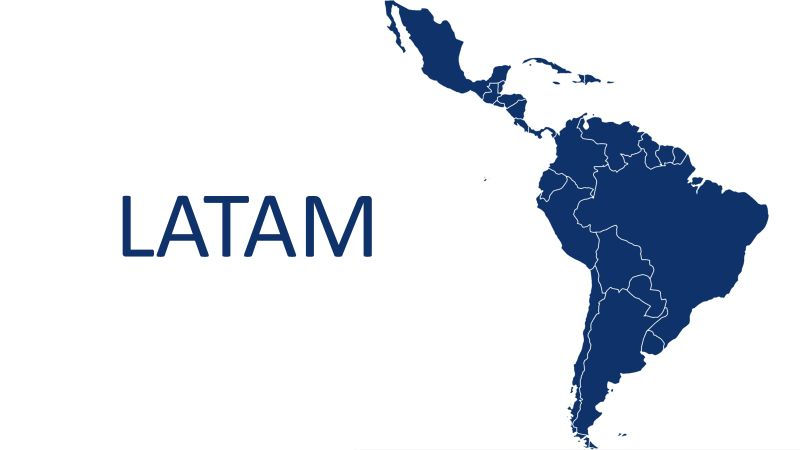
South America (LATAM)- Understanding the Different Regulatory Requirements


Mexico or Brazil – what is worth knowing when exporting cosmetics?
Before exporting cosmetics to Mexico or Brazil and proving compliance with regulations then placing them on the market, the exporter must prepare and submit the appropriate supporting documentation to the local legal representative/importer.
Neither country allows direct registration by foreign manufacturers – regulatory compliance is assessed locally, and a marketing authorization (or equivalent) is issued to the Brazilian/Mexican entity.
The exporter's role is to generate technical data on safety and quality, which the local partner submits to the authorities (COFEPRIS in Mexico; ANVISA in Brazil).
Mexico (regulated by COFEPRIS)
Cosmetics safety typically does not require sanitary registration before being placed on the market. Instead, compliance focuses on manufacturing authorization, labeling, ingredient regulations, and GMP equivalence. Marketing is permitted once the local entity has obtained the required notifications and the product meets all standards.
Key requirements and documentation that the exporter must submit to the local representative:
Local Representative (LR) Appointment: A Mexican entity/person (distributor, subsidiary, or third party) who assumes legal responsibility. The exporter must issue a power of attorney (Apostille) and provide company documents (registered address, tax identification number, etc.).
Notification of Action (Aviso de Funcionamiento): The LR submits this via the DIGIPRIS platform. It authorizes the Mexican company to import/distribute. No product-specific documentation is provided, but the exporter provides detailed information about the product.
Ingredient Compliance Statement: A complete qualitative and quantitative formula (INCI names, percentages) confirming compliance with the COFEPRIS lists of permitted/prohibited/restricted substances (e.g., no mercury compounds, specified limits for dyes/preservatives/UV filters). A technical justification for any restricted substances must be included.
Proof of GMP equivalence: A certificate or declaration confirming production compliance with the NOM-259-SSA1-2022 standard (or an equivalent international standard, e.g., ISO 22716). Importers must demonstrate this for imported products.
Safety and quality data: Cosmetic Product Safety Report (CPSR) or equivalent toxicological assessment, stability data, microbiological/chemical analysis certificates (heavy metals, preservatives, etc.). These must be kept and available to COFEPRIS upon request (after placing on the market, but often required during import).
Label design and compliance documentation: Proposed labels (in Spanish according to the NOM-141-SSA1/SCFI-2012 standard) containing the product name, net quantity, ingredients (INCI), manufacturer/importer address, country of origin, batch/lot, expiration date/PAO (if ≤24 months), instructions for use, and warnings. The exporter provides the draft; the LR ensures final compliance. Certificate of Free Sale (optional, but strongly recommended): Issued by the relevant EU authority or the exporter's national authority, confirming the legal marketing of the product in the country of origin.
Import/customs documentation (managed by the importer but supported by the exporter):
Commercial invoice, packing slip, airway bill, certificate of origin (if USMCA preferences apply).
Proof of labeling compliance or commitment to relabeling in Mexico.
Affidavit/declaration that the product is a cosmetic (in some cases, a UVA certificate of compliance is also required).
Once the importer (LR) has obtained a Notification of Business and Labeling Compliance, the product may be imported and placed on the market. Advertising may require a separate license.
Brazil (regulated by ANVISA)
Brazil has a two-tier registration system under RDC 907/2024 and RDC 949/2024: most products require notification (Tier I/low risk), while certain higher-risk products (e.g., sunscreen, hair straighteners, insect repellents, baby products) require full registration (Tier II). Before submitting an application, the Brazilian company must have a valid Authorized Entry Form (AFE) - (Autorização de Funcionamento de Empresa).

Key requirements and documentation that the exporter must submit to the Brazilian legal representative/importer:
1. Appointment of Brazilian legal representative: Locally registered company with an AFE (business license). Exporter issues a letter of authorization/declaration (often notarized/apostille).
2. Confirmation of product classification: Data to determine level I (notification) or level II (registration).
3. Product Composition Sheet (PCS) / full formulation documentation: Qualitative and quantitative composition (INCI or Brazilian nomenclature, centesimal percentages), function of each ingredient. For registered products, this often requires consular certification (stamp of the Brazilian consulate/embassy in the country of origin).
4. Safety, stability, and efficacy data.
5. Toxicological/safety assessment (equivalent to the CPSR EU).
6. Stability tests (especially for level II: under stressed, accelerated and real-time conditions).
7. Efficacy/verification studies, if applicable.
8. Microbiological, heavy metal, and other quality control test reports
9. GMP/Production Information: Good Manufacturing Practices for Cosmetics (BPFCos) declaration or certificate. ANVISA may accept foreign equivalents (e.g., ISO 22716) but verifies them through a local partner.
10. Label Proposal: Full graphic design and text in Portuguese (in accordance with RDC 907/2024), including product name, AFE number, batch number, expiration date, ingredients, instructions for use, warnings, country of origin, and importer details. Therapeutic claims are not permitted.
11. Free Sale Certificate (often required): From the country of origin, often consular.

Notification/Registration Process (managed by the Brazilian partner):
Level I: `Prior Notification`/notification via the SGAS ANVISA platform → published online → can be placed on the market.
Level II: Full application with documentation → ANVISA technical review + possible inspection → approval published in the Diário Oficial da União (DOU) → valid for 5-10 years.
Import documentation (required before shipment)
o Electronic Import Petition (PEI) via Siscomex/Único Portal, including an Import License (LI) pre-approved by ANVISA.
o Commercial invoice, bill of lading, registration holder declaration, AFE proof, and product legalization.
o ANVISA conducts sanitary inspection/admission at the border/port.
o Placing on the market is permitted only after notification/publication or approval of the registration. The Brazilian company must also have a cosmetics monitoring system.

Advice for EU Exporters
A basic documentation package to prepare in advance: the full formulation, safety report, stability data, GMP certificate, analysis reports, proposed labeling, and a certificate of free sale. This forms the basis for local reporting in both countries.
Adverse event reporting and documentation are mandatory.
Reference:
COFEPRIS (DIGIPRIS) – Mexico
ANVISA – Brazil


Comments